
[Job Hunting Interview] Write Your Entry Sheet in Your Own Words, with Logic | Video Editor A

Hello, this is Y from the staff.
Job hunting in Japan comes with plenty of worries. Maybe you spent a long time on your ES (entry sheet, the written application form many Japanese companies require) and it was rejected. Or maybe you didn't know how to prepare for interviews and it didn't go well.
Many of you probably want to know what HR staff and interviewers actually pay attention to.
To help, 19Studio interviewed people who have reviewed job hunters' ES and served as interviewers.
This time, we spoke with A, who works as an editor in the video industry. What does A value in an ES and in interviews?
Contents
A's Career

Video Editor A
After graduating from university, A went on to a vocational school for video editing.
After finishing vocational school, A joined a subsidiary of a major electronics manufacturer and worked in its video production department. A then worked at two video production companies and is now a freelance video editor.
A Careful, Logical ES Stands Out
Y: Thank you for joining us today. Let's start with the entry sheet.
When you review an ES, what do you focus on?
A: I focus on whether the applicant can see themselves objectively. A desire to improve matters too.
Because video production is our field, it's an extra plus if someone is sensitive to information and trends and has good antennas up.
Y: “Seeing yourself objectively” means having done good self-analysis. It really shows that self-analysis is important in job hunting.
Y: What do you look for in the self-promotion section?
A: It sticks with me when it's written carefully and logically so the reader can follow it. If the applicant states the conclusion first and then explains each point, it's easier for me to remember.
Y: True, it's easier to understand when the conclusion comes first. That way of answering would work for other questions and interviews too, not just self-promotion.
A: Yes. You'll use it in actual work as well, so it's good to get used to it while job hunting.
Y: What do you look for in the motivation section (why you want to join)?
A: It matters whether they understand not only what the company does, but also its position in the industry and its outlook. With that understanding, I evaluated how well it matches what the applicant wants to do.
Y: I see. So it's important to research the company and the industry thoroughly.
A: To avoid the “this isn't what I expected” problem after joining, I'd like applicants to research and understand the industry in their own way.
Y: A classic ES question is “Gakuchika” (what you put effort into during your student years). Why do you ask it?
A: To picture how they would contribute at our company. It's also a way to check whether they are someone who thinks and acts on their own.
Y: Many people struggle to choose a Gakuchika episode, but keeping those two points in mind should make it easier.
Y: What do good ES have in common?
A: They answer the question that was actually asked. They also don't overestimate the applicant.
Y: You mentioned earlier the method of stating the conclusion first and then giving details. That should also help you answer the question correctly.
ID Photos: Sincerity Is Key
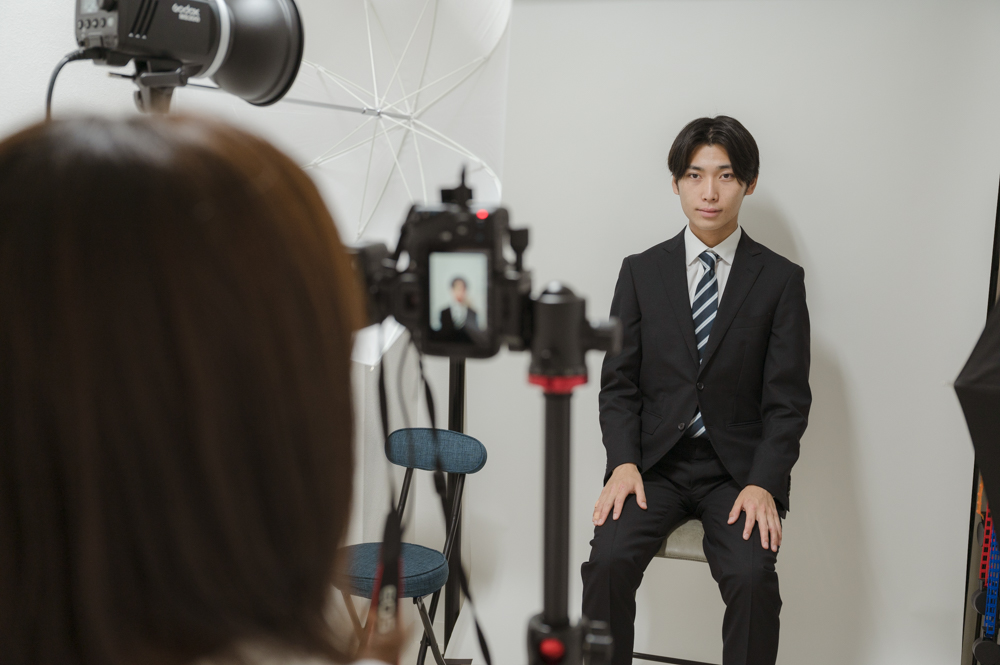
Y: Next, the ID photo, which is a must for an entry sheet.
Are there hairstyles, makeup, postures, or expressions that make a good impression?
A: For hair, a clean, neat look matters most. For men, short black hair is good; for women, a hair color that isn't too light. Makeup is safest when it isn't too flashy.
For posture, chest open and looking confident makes a good impression. A slight smile is about right for the expression. For lighting, not too bright and not too dark is best.
I think it's enough if you look sincere and like a good communicator at first glance.
Y: Sincerity really is important.
Y: Does the impression from an ID photo like that affect whether someone passes or fails?
A: It's hard to say either way. I can't say it clearly affects the result, but it's not that it has no effect at all.
In Interviews, Answer in Your Own Words
Y: Now, what do you pay attention to in interviews?
A: I look at whether they can answer questions in their own words. I also care about whether anything in their wording is unpleasant to listen to.
If someone can't look me in the eye or speaks extremely quietly, I start to have some doubts about their communication skills.
Y: So it helps to look the interviewer in the eye and speak firmly in your own words.
Y: What separates people whose evaluation goes up from those whose goes down, in the ES and the interview?
A: When someone has a unique point of view or talks about what they're particular about in a hobby, it makes their personality and potential easy to see, which leaves a good impression.
People whose interview contradicts their ES may leave a worse impression.
Y: If you write in your own words from the ES stage, you can avoid contradictions with your interview.
A: Exactly. If you're confident in your own opinions, you can express them in your own words.
Summary
This time, we talked with A, an editor in the video industry!
Whether in writing or in person, we learned that it's important to express yourself in your own words.
It may feel hard at first, but try practicing putting your experiences and feelings into words.
- I have conducted hiring interviews at both listed companies and startups. Drawing on my experience reviewing applications and ID photos as an interviewer, I explain what recruiters really look at in your photo and entry sheet.
Latest posts
 Job-Hunting ID PhotosNovember 9, 2026Resume Photos for Job Changes in Japan: Size, Attire & Where to Shoot
 Job-Hunting TipsFebruary 16, 2023Job-Hunting Interview: What New-Grad Hiring Managers Really Want Isn't Your Motivation—It's "Hou-Ren-Sou" | Web Designer Mr./Ms. I
 Job-Hunting TipsDecember 15, 2022[Job Hunting Interview] Write Your Entry Sheet in Your Own Words, with Logic | Video Editor A