
[Job Hunting Interview] What Recruiters Really Look For: Passion and Sincerity for the Job | K, Engineer

Hello, this is Y from the staff.
Once job hunting in Japan begins, many students wonder how to present themselves in their resumes, ES (entry sheets, the application forms companies use to screen new graduates), and interviews. You may also want to know what HR staff and interviewers actually pay attention to.
To help answer that question, 19Studio has been interviewing people who have reviewed job seekers' entry sheets and served as interviewers in real hiring.
This time, we spoke with K, who works as an engineer in the IT industry. K says that the “reason for applying” isn't a major factor. So what does K value most?
Contents
K's Career

K, Engineer
After graduating from university, K worked at a major web production company and at a video-focused IT startup, among others.
K has served as an interviewer for new-graduate hiring at both a large company and a startup, so K understands how recruiting differs depending on company size.
Past work and projects make it easier to picture you
Y: Thank you for joining us today. Let's start with the entry sheet.
When you review an ES, what do you focus on?
K: I focus on what kind of motivation the person has. Since we'd be working together, it matters whether their mindset fits with ours.
Y: So a shared mindset really matters when you work side by side.
Y: What about the “reason for applying”? What do you look for there?
K: I look at whether there's a mismatch between the work and experience the company can offer and what the applicant wants to do.
Y: So students should say what they want to do in that section. Together with what you said about mindset, it's clear that you hire with the aim of avoiding mismatches.
K: Right. I think the best outcome is when both sides feel it's a good fit, so I pay close attention to that.
Y: Then, what kind of self-promotion statement leaves an impression?
K: From an engineer's perspective, websites or apps you've worked on in the past stand out. When there's something concrete you've made, I can picture the person, and it's easier to remember them.
Y: I see. These days, a lot of students build their own sites and apps.
K: Yes, and I think that's great. If you have that kind of experience, I'd like you to show it proactively.
Y: Why do you ask about “gakuchika” (what a student put effort into during their school years)?
K: It's to find out whether they truly want to turn what they love doing into their career.
I think the role of the “gakuchika” question is to see what the person has thought about based on their own experience, and to gauge their passion and seriousness about work.
Y: We've talked about the ES. In your view, what do good ESs have in common?
K: They include plenty of projects and achievements. When the applicant describes what they actually did, it's easy to imagine what kind of things they've done and what skills they have.
Y: So it's important to let the reader connect your experience to the actual job as realistically as possible.
A poor ID photo could affect the outcome
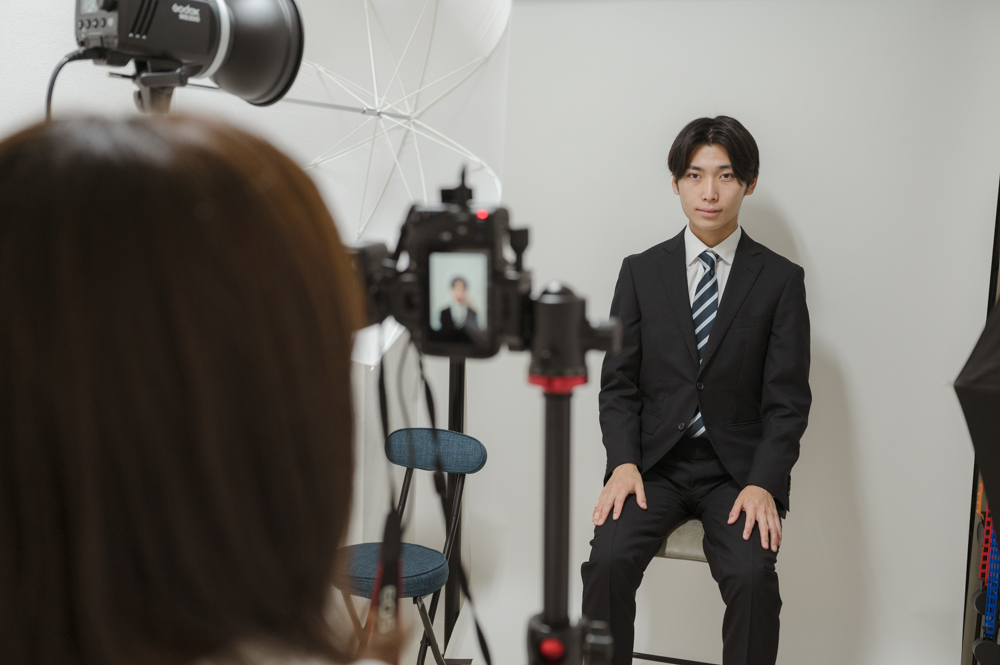
Y: Next, the ID photo, which is an essential part of the entry sheet.
Are there hairstyles, makeup, postures, or expressions that make a good impression?
K: I think a photo with minimal retouching that looks bright is good. It also shows whether the person takes care to look neat and clean.
Y: With bright lighting, you really do get a stronger sense of cleanliness.
Y: Does the impression from an ID photo affect whether someone passes or fails?
K: It's hard to say either way. A good photo won't get you hired by itself, but that doesn't mean a poor impression is completely harmless, either.
In interviews, it's not just your words but the feelings behind them that are evaluated
Y: What do you focus on in interviews?
K: I focus on the applicant's feelings, meaning whether they really want to do this work and want to work here, or not. I evaluate not only the words but the feelings behind them.
Y: Many students lose track of where they want to work or what they want to do during job hunting, so it seems worthwhile to take time to reflect on that.
Y: What separates people whose evaluation goes up from those whose evaluation goes down, between the ES and the interview?
K: If what's in the ES and what's said in the interview don't match, the evaluation drops. On the other hand, when the ES and the interview are consistent, the person comes across as trustworthy.
Y: You're right, consistency builds trust.
K: I'd like applicants to organize their own thoughts and opinions first, then write the ES and go into the interview.
Summary
This time, we talked with K, who works as an engineer in the IT industry!
K clearly values things that let them picture the applicant actually doing the job, such as real experience and finished projects. We hope job seekers found some new insights here.
Keep in mind what recruiters look for in ESs and interviews as you prepare for your job search!
We hope this helps!
- I have conducted hiring interviews at both listed companies and startups. Drawing on my experience reviewing applications and ID photos as an interviewer, I explain what recruiters really look at in your photo and entry sheet.
Latest posts
 Job-Hunting ID PhotosNovember 9, 2026Resume Photos for Job Changes in Japan: Size, Attire & Where to Shoot
 Job-Hunting TipsFebruary 16, 2023Job-Hunting Interview: What New-Grad Hiring Managers Really Want Isn't Your Motivation—It's "Hou-Ren-Sou" | Web Designer Mr./Ms. I
 Job-Hunting TipsDecember 15, 2022[Job Hunting Interview] Write Your Entry Sheet in Your Own Words, with Logic | Video Editor A
Related articles
 Job-Hunting Tips
[Job Hunting Interview] Make Your Motivation Clear and Easy to Understand | Business Planner S
An interview with a former HR interviewer, now a business planner at a major IT and telecom company, on what they look for in entry sheets (ES) and job interviews in Japan.
 Job-Hunting Tips
[Job Hunting Interview] Recruiters Look at How You Handle Trouble in Your "Gakuchika" | T, IT Industry
What do people who hire new graduates look for when they read entry sheets and interview candidates? We asked T, who works in the IT industry, to share the behind-the-scenes of Japanese new-grad hiring.
 Job-Hunting Tips
[Job Hunting Interview] Thorough Self-Analysis Makes a Better Entry Sheet | T, Systems Engineer
What do recruiters who hire new graduates look for when they read entry sheets and conduct interviews? We asked T, who works in the IT industry, to share the behind-the-scenes view of graduate hiring in Japan.
 Job-Hunting ID Photos
Airline Job Hunting ID Photos: How They Differ, Plus Studios to Try
Aspiring flight attendants and ground staff put real effort into their ID photos. How do they differ from standard ones? Here's a guide to airline-industry job hunting photos.
 Job-Hunting ID Photos
Photos for Announcer Job Hunting in Japan: What to Know (Plus Photo Studios)
Getting hired as a TV announcer in Japan is extremely competitive. Learn how announcer job-hunting ID photos differ from standard ones, what to watch for, and which studios to try.
 Hair, Makeup & Outfits
Too Hot! Can You Wear Short Sleeves for a Japanese Job-Hunting Photo?
Getting your job-hunting photo taken for summer internships or early recruiting? Here's how to stay cool and still look sharp, from short sleeves to suit overlays.