
[Job Hunting Interview] Recruiters Look at How You Handle Trouble in Your "Gakuchika" | T, IT Industry

Hello, this is Y from the staff team.
Once job hunting in Japan begins, many people wonder how to present themselves on their résumé, their ES (entry sheet, the application form most Japanese companies require) and in interviews. What do HR staff and interviewers actually pay attention to? You may be curious about that too.
To help answer that question, 19Studio has been interviewing people who have reviewed job applicants' ES and served as interviewers.
This time we spoke with T, who works in the IT industry and has also interviewed candidates at a major company. What do they look for in an ES and in an interview?
Contents
T's Career

T, IT Company Employee
T has worked at the headquarters of a major convenience store chain and at a large internet services company, among others. T now works at a publicly listed company and often takes part in new-graduate hiring as an interviewer.
Do You Share the Company's MVV?
Y: Thank you for joining us today. Let's start with questions about the entry sheet.
When you check an ES, what do you focus on?
T: I look closely at how the applicant dealt with trouble when it came up in real work, such as a part-time job. The result of that approach matters, and so does how well they can picture what result it would lead to.
Y: It's interesting that you look at how people handled trouble, not at what went well. I think it also shows their quick judgment and composure.
Y: What do you focus on in the statement of motivation (why you want to join the company)?
T: Whether the person relates to the company's MVV*. I also care about why they relate to it. If this doesn't match, it leads to a mismatch, so I listen carefully.
*MVV stands for Mission, Vision and Values.
Y: I see. So it's a way to prevent mismatches.
T: Yes. The best thing is to work somewhere that fits your own values.
Y: Next, why do you ask about "Gakuchika" (short for "what you put effort into during your student years", a standard question in Japanese job hunting)?
T: Through Gakuchika, I want to learn about the student's teamwork, perseverance and communication skills. I think it's best when your answer shows all three.
For Your ID Photo, Focus on Expression and a Clean Look!
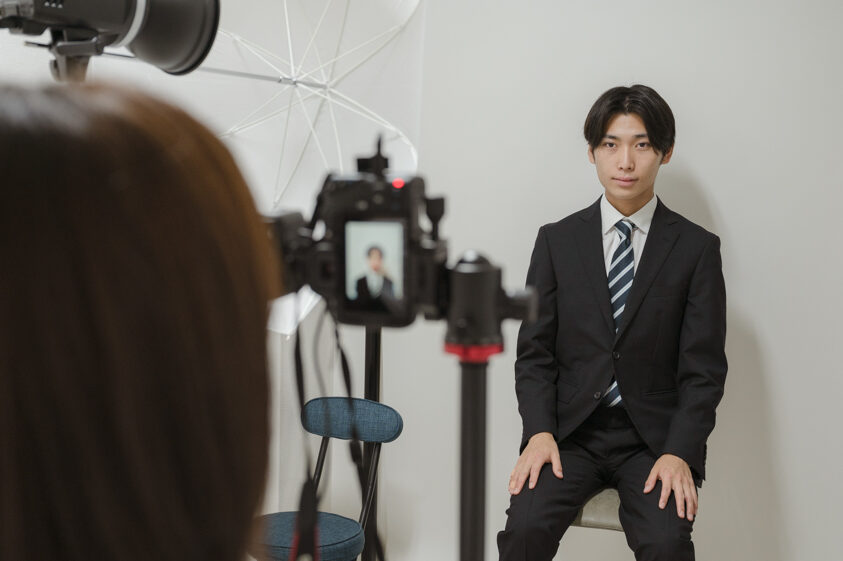
Y: Now let's talk about the ID photo, which is essential for an entry sheet.
Are there hairstyles, makeup, postures or expressions that make a good impression?
T: Expression is important. Showing your teeth isn't ideal in an ID photo, so a smile where the corners of your mouth are just slightly raised makes a good impression. A clean, neat look matters too, so it's a good idea to pay attention to your grooming, including your hair.
Y: Does the impression from the ID photo affect whether someone passes or fails?
T: The photo doesn't decide the result, but it has a small effect.
Y: So it does have some effect. To avoid any negative impression, it's best to prepare a photo with a moderate smile and a clean, tidy look.
In Interviews, Communication Skills Matter Most, Which an ES Can't Show
Y: What do you focus on in interviews?
T: I look at whether the person has other areas they want to expand into, rather than sticking to just one thing. At work, you often end up handling a variety of tasks.
I also think it's very important whether I can sense a drive to improve and whether they have good communication skills.
Y: Communication skills are often something you only see by actually talking with someone in the interview.
T: Right. In interviews, I pay special attention to what you can't tell from writing alone.
Y: What separates people whose evaluation goes up from those whose evaluation goes down between the ES and the interview?
T: It's exactly communication skills. That's where the biggest difference shows.
Also, people whose stories leave an impression tend to get higher marks in interviews.
Y: I see. Even with the same content, the impression changes depending on how you tell it.
T: Yes. I think that's part of communication skills too.
Summary
This time we heard from T, who works in the IT industry!
A solid statement of motivation is important, but it seems you also make a better impression if you can picture how you want to contribute after joining the company.
We hope this helps everyone who is job hunting!
- I have conducted hiring interviews at both listed companies and startups. Drawing on my experience reviewing applications and ID photos as an interviewer, I explain what recruiters really look at in your photo and entry sheet.
Latest posts
 Job-Hunting ID PhotosNovember 9, 2026Resume Photos for Job Changes in Japan: Size, Attire & Where to Shoot
 Job-Hunting TipsFebruary 16, 2023Job-Hunting Interview: What New-Grad Hiring Managers Really Want Isn't Your Motivation—It's "Hou-Ren-Sou" | Web Designer Mr./Ms. I
 Job-Hunting TipsDecember 15, 2022[Job Hunting Interview] Write Your Entry Sheet in Your Own Words, with Logic | Video Editor A