
[Job Hunting Interview] Thorough Self-Analysis Makes a Better Entry Sheet | T, Systems Engineer

Hello, this is Y from the staff team.
You spend a long time agonizing over an ES (entry sheet, the application form used in Japanese job hunting), and it still gets rejected. You don't know how to prepare for interviews, and they don't go well. Job hunting worries never seem to end, do they?
Many of you probably want to know what HR staff and interviewers actually pay attention to.
To help with these worries, 19Studio interviewed people who have reviewed students' ESs and served as interviewers in real graduate hiring.
This time, we spoke with T, who works as a systems engineer in the IT industry.
Contents
T's Career

T, Systems Engineer
T joined the current company right after graduating, in the IT and system integrator (SIer) industry, and works as a systems engineer.
T has been involved in graduate hiring as an interviewer for many years.
For "Gakuchika," Recruiters Want to Know How You Worked Hard
Y: Thank you for joining us today. Let's start with entry sheets.
When you check an ES, what points do you consider most important?
T: I put weight on achievements in club activities and similar experiences and on relationships with the people around you. I look closely at whether someone is an individual player or a team player, because it affects how they work. Neither one is better than the other.
Y: I see. Knowing how someone builds relationships with others helps you picture what they would be like after joining the company.
T: Right. Working means dealing with people, so I also look at how well someone would fit in with the existing team members.
Y: Next, what kind of self-PR (the section where you promote your strengths) stays in your memory?
T: A self-PR built on an episode that shows who the student is as a person stays with me.
Y: People tend to focus on showing off their skills, but it's also important to convey your personality.
Y: What do you focus on in the motivation section (why you want to join the company)?
T: I look at whether the work environment the applicant wants matches the real one, and even if it doesn't match exactly, whether the gap isn't too big. The main purpose is to prevent a mismatch after the person joins.
Y: Why do you ask about "gakuchika" (what you put effort into during your student years)?
T: It shows the basics needed to become a working professional, as well as perseverance and a willingness to make an effort. I'm glad when I can learn how the student worked hard.
Y: So you value the process more than the results or how impressive the episode is.
T: Yes. The process lets me imagine how the person would get results at work, so that's what I focus on.
Y: What do good ESs have in common?
T: When someone has done thorough self-analysis, they understand their own strengths and weaknesses, and I think that makes a good ES.
Y: When you know yourself well, the company can understand you accurately too, so it works well for both sides.
Brightness and a Clean, Fresh Look Are Key for ID Photos
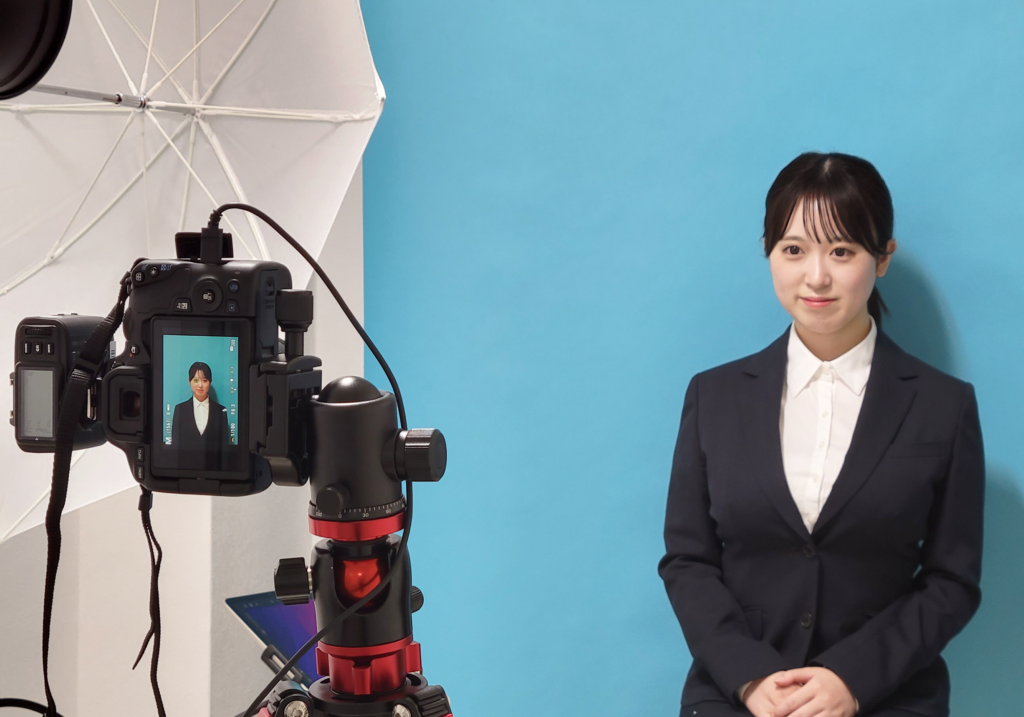
Y: Now let's talk about the ID photo, which is essential for an entry sheet.
Are there hairstyles, makeup, postures, or expressions that make a good impression?
T: I think a hairstyle that clearly shows the eyes and natural makeup are good. As for expression, a smile is better. An overall clean and fresh look makes a good impression. Brightness and a clean look really are important.
Y: Brightness and a clean look. Those are the basics of an ID photo.
Y: Does the impression from an ID photo affect whether someone passes or fails?
T: I can't say it does or doesn't. If the impression is really bad, for example if there's no sense of cleanliness at all, I think it can have an effect.
In Interviews, Focus on How You Answer
Y: What do you focus on in interviews?
T: I look at whether the student can respond properly. Students who understand the intent of our question and answer accordingly get high marks, I think.
Y: It's actually quite common for people to be so focused on what they want to say, or so nervous, that they don't answer what was asked.
T: Yes. An interview is a conversation too, so it helps to keep that in mind.
Y: What separates people whose evaluation goes up from those whose evaluation goes down between the ES and the interview?
T: Evaluations go up for people who state their opinions clearly and confidently. On the other hand, evaluations go down when the person in the interview feels too different in tone and enthusiasm from the ES.
In interviews, the way you speak, which you can't tell from the ES, becomes important.
Summary
This time we talked with T, who works as a systems engineer!
It seems interviewers pay attention to each student's individuality and try hard to see what kind of person they are.
Showing off your skills and achievements is effective, but it also seems to help to share your personality and how you approach things.
We hope this is useful for everyone job hunting!
- I have conducted hiring interviews at both listed companies and startups. Drawing on my experience reviewing applications and ID photos as an interviewer, I explain what recruiters really look at in your photo and entry sheet.
Latest posts
 Job-Hunting ID PhotosNovember 9, 2026Resume Photos for Job Changes in Japan: Size, Attire & Where to Shoot
 Job-Hunting TipsFebruary 16, 2023Job-Hunting Interview: What New-Grad Hiring Managers Really Want Isn't Your Motivation—It's "Hou-Ren-Sou" | Web Designer Mr./Ms. I
 Job-Hunting TipsDecember 15, 2022[Job Hunting Interview] Write Your Entry Sheet in Your Own Words, with Logic | Video Editor A