
[Job Hunting Interview] Make Your Motivation Clear and Easy to Understand | Business Planner S

Hello, this is Y from the staff.
When job hunting begins in Japan, many people wonder how to present themselves on their résumé, their ES (entry sheet, the application form most companies require) and in interviews. You may also want to know what HR staff and interviewers actually pay attention to.
To help answer these questions, 19Studio interviewed people who have reviewed job seekers' entry sheets and worked as interviewers.
This time we spoke with S, who works at a major IT and telecom company. We asked not only about entry sheets and interviews, but also about grooming and appearance!
Contents
S's Career

Business Planner, S
After joining a large internet company as a new graduate, S worked at several companies, including a mobile carrier.
Today, S is in charge of business planning at a major company in the IT and telecom industry.
Picture how you will work after joining through your motivation
Y: Thank you for joining us today. Let's start with entry sheets.
When you review an ES, what do you focus on most?
S: I focus on whether the applicant's reason for applying is clear.
Y: More specifically, what do you look for in the motivation section?
S: Whether it is clear what they want to do after joining the company. When it is written concretely, it is easy to imagine how that person would perform after joining, and that leaves a good impression.
Y: So the most important thing is being able to picture them actually working at the company.
S: Yes. On top of that, I like people who fit the company and who we would want to work with.
Y: What kind of self-promotion stays with you?
S: I remember applicants who describe what they worked hard at in student life or club activities, or who share achievements or interesting experiences. If someone has something that makes them stand out from others, I tend to remember them.
Y: True, people with experiences different from everyone else's do stand out.
Y: Then, why do you ask about “gakuchika” (what applicants put the most effort into as students)?
S: To see whether they already had the ability to spot problems, think things through and take action back in their student days.
It also helps me get a sense of the person's character.
Y: Problem-spotting, thinking and taking action seem directly connected to the job itself.
S: They are. These are skills you need to get work done, so I place particular importance on them.
Y: What do the entry sheets you consider good have in common?
S: They are easy to read at a glance, and the main points jump out right away.
Content matters, of course, but first of all clarity and getting your message across are what count.
For ID photos, a clean, neat look matters most!
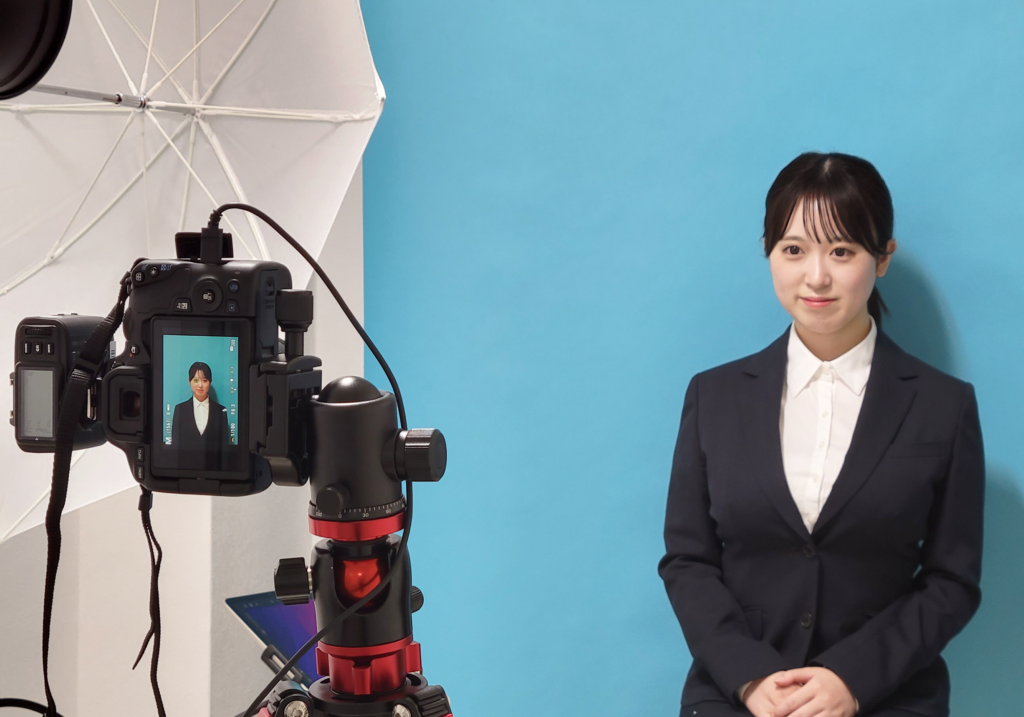
Y: Next, let's talk about the ID photo, which every entry sheet needs.
Are there hairstyles, makeup, postures or expressions that make a good impression?
S: A bright expression and a clean, tidy hairstyle and outfit are best. If you wear makeup, natural and moderate makeup makes a good impression.
Y: So, does the impression from the ID photo affect whether someone passes?
S: If anything, yes, it does. A photo that doesn't look clean and neat doesn't leave a good impression.
Y: So for an ID photo, looking clean and neat is the most important thing.
In interviews, watch how you speak and your posture
Y: What do you focus on in interviews?
S: I focus on the person's character and their experiences as a student. I want to know what experiences shaped who they are.
Y: So in the interview you dig deeper into what they wrote about gakuchika and self-promotion.
Y: Then, what separates applicants whose evaluation goes up from those whose evaluation goes down between the ES and the interview?
S: Evaluations split on things you can't tell from the ES alone, such as how they speak and their posture.
Y: You're right, you can't tell how someone speaks or carries themselves from an ES. It sounds like mock interview practice is worth doing.
Summary
This time we heard from S, who works at an IT and telecom company!
The key message was make your motivation clear and easy to understand. Be specific about what you want to do after joining, so the company can picture you doing well there.
Beyond the content itself, a clean and neat appearance, the way you speak and your posture also count. If you feel unsure about how you speak or carry yourself in interviews, it may help to practice with a friend, family member or teacher.
We hope this is useful to everyone job hunting!
- I have conducted hiring interviews at both listed companies and startups. Drawing on my experience reviewing applications and ID photos as an interviewer, I explain what recruiters really look at in your photo and entry sheet.
Latest posts
 Job-Hunting ID PhotosNovember 9, 2026Resume Photos for Job Changes in Japan: Size, Attire & Where to Shoot
 Job-Hunting TipsFebruary 16, 2023Job-Hunting Interview: What New-Grad Hiring Managers Really Want Isn't Your Motivation—It's "Hou-Ren-Sou" | Web Designer Mr./Ms. I
 Job-Hunting TipsDecember 15, 2022[Job Hunting Interview] Write Your Entry Sheet in Your Own Words, with Logic | Video Editor A